Showing posts with label Introducing solids. Show all posts

Monday, July 1, 2013

6 important things to do BEFORE your baby starts on solid foods


1. Consider taking an infant CPR/choking class or if you already have, brush up on what to do in the event of a choking situation. While it's very unlikely your baby will truely choke (vs gagging) if you're using safe feeding techniques, it can happen & you'll feel much more confident if you know exactly what to do.

2. Bring baby to the table to let him/her watch you eat. Hold your baby on your lap. Talk to your baby about foods you are eating. Say the names and tell him/her how the food tastes. 

3. Start letting your baby play with spoons, cups, and bowls outside of mealtime. 

4. Take note of your baby's breast/bottle feeding schedule and try to get a general sense of when he/she eats. Also note  when during the day he/she is most calm, alert, interactive. This will serve as a guide for scheduling solids food meals. Aim to identify a time when your baby is awake and well rested, calm, and not hungry. First meals are all about taste and exploration, not eating and quantity so there is no need for your baby to be hungry. 

5. Talk to your pediatrician about any potential allergy risks or special considerations for your baby with feeding. 

6. Have the equipment you need ready: out of the packaging, clean, set up if needed, & familiar to you so your not struggling or using incorrectly at first. I suggest considering the following:
- non-breakable bowls/plates
- child size spoons
- bibs
- high chair or booster seat with safety straps
- splash mat
- lots of towels
- an apron for you to wear (sounds excessive but feeding is messy business at first!)

Tuesday, June 25, 2013

5 signs your baby is ready to start solids (not age based!)


Pretty much across the board pediatricians encourage parents to start solid foods at a certain age (some say 4-6 months, others suggest around 6 months, others 6 months and older.) Between 4 to 6 months is the most common time frame, but this is a HUGE spread in baby time.


Major skills and maturation occurs between 4 to 6 months, such as the ability to sit independently. While we can't see it as obviously, your baby's body is also maturing and growing on the inside (the stomach, reflex patterns, and immune system for example are all changing during this time.)

Age is a vaguely helpful guideline but each baby is SO different that age is an unreliable indicator and should actually be low on our list of check offs that help you decide if your baby is ready to transition to solid foods. The primary indicators of readiness are developmental skills and interest. That means, your baby should have the following skills/signs to show you that she or he is ready to start eating solid foods:

1. Head and neck control- not wobbly at all. Your baby should be able to hold his head up while sitting, by himself for at least 15-20 minutes. 

2. Trunk control/sitting independently- possibly a bit wobbly but at least sitting for a few minutes by herself if placed in a sitting position without toppling over. Even better if she can get into and out of a sitting position by herself. 

3. Fine motor coordination- to reach for and grab items and bring to the mouth. This can be toys, a spoon, or food. Your baby should have enough eye/hand coordination to at least reach towards objects and push them around the table while trying to pick them up. 

4. An emerging pincer grasp (picking a smaller item up with the pads of the thumb and index finger)- around the same time that your baby is ready to begin solid foods, she will also be starting to try to pick up smaller and smaller items that she comes across (lint on the floor, stray dog food, anything gross and small will probably catch your baby's attention.) 

5. An active interest in food, watching you eat, being a part of the meal, and touching/exploring food-the motor skills I mentioned above will generally coincide with your baby's overall interest in food and  eating. Your baby will go from being fairly content to sit in your lap or in a sling while you're at the table and maybe even nap through a meal, to wanting to be a part of it all. He will try to grab food from your hands and off your plate. He will intently watch you bring food to your mouth. If you let your baby be a part of your mealtimes, around the time he or she is ready to start solids you'll see a distinct interest as though your baby is asking for you to let him/her eat!

Saturday, June 15, 2013

Baby Led Spoon Feeding


Babies are born learners and explorers. They find joy in exploring and mastering a skill. Babies are driven to do this and will learn and explore with food if we give them the opportunity to do so at their own pace. If we let this joy flourish and let them feel confident and successful, they will have a positive relationship with food that will last a lifetime. This is especially true for the more reticent feeder, who may never eat vigorously for the sheer love of it, but who will learn to eat what she or he needs and enjoy it. It holds true for all babies. Often the more we push them to eat or stop eating, the less likely they are to do so.

With this in mind, I'll offer my tips for baby led spoon feeding. Spoon feeding is primarily an adult let activity and can easily lead to a disconnect between patent and child's communication if we aren't  proactive about being "tuned-in". These tips are focused on making spoon feeding an interactive dance or a conversation. 

- Let your baby take the lead by giving him or her a spoon to hold from the very beginning. 

- Expect the activity to get messy and be ok with that. Mess is fun and it enriches the sensory experience. Your baby is learning a new skill and she can't do it perfectly from the start. If your baby isn't getting messy that means you're controlling the activity and doing it for them, which means your baby is not learning as much and probably not enjoying it as much. 

- Forget about quantity. Let the focus be on exploration and discovery, even if that means that zero amounts of food is actually swallowed or even tasted.


- Try loading the spoon for your baby at first, then just set it on the table, handle towards your baby. Let your baby pick it up and do whatever she or he wants with it!

- If your baby is struggling and appears interested, hold and offer the spoon directly to your baby. Keep the spoon near your baby's mouth and wait. Do not touch your baby's lips or try to put it in his or her mouth. Just wait until your baby opens his or her mouth or leans towards the food. If that never happens, eat the food yourself and let your baby just watch or touch the food if interested. 

- At all meals, try to have your own spoon and bowl of food to eat. Model eating and enjoy a meal with your baby. Babies and children learn best from watching you. They want to do what you're doing. If he is eating applesauce, you should eat applesauce. 

- If your baby is into the food and the activity, re-load the spoon and offer it again. 

- If not, let him or her enjoy time at the table, touching and playing with the food with his or her hands while you eat. Do not stress or worry. Offer a milk feed (breastmilk or formula) instead. 

Tuesday, June 11, 2013

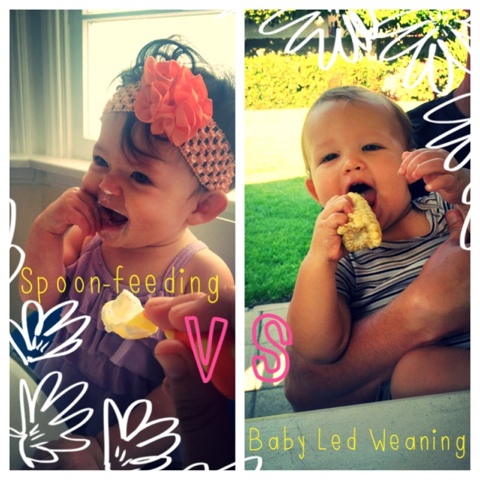
Traditional Puree/Spoon-fed Approach VS Baby Led Weaning

Baby Led Weaning vs spoon feeding

"Why have an 'approach' at all?" you might ask.  This may seems silly to those who just "do it" and never even consider what their personal "approach" might be.  "We just fed you" my mother said when I asked her about what she did for me.  "We didn't stop to think about approaches." 

4 generations of daughters enjoying lunch together.  We all were fed in different ways and I'd say we all turned out fairly well!

I get this.  Many people are too busy to consider the intricacies of a feeding style or they inherently trust their parenting skills and would never second guess themselves or confuse things by reading about someone's feeding philosophy.  But, many parents don't have this same sense of self-confidence or experience, and because we are more isolated than ever these days, we also don't have family or friends we can easily turn to for guidance. Additionally, if we look around at the incredibly high rates of picky eating childhood and adult obesity as well as the unbelievably high rates of funky childhood diseases, like autism, type II diabetes, asthma, and allergies, and digestive disorders (like Crohn's or Celiac), I think it becomes clear that whatever we have been doing--even when we are confident about it--has not really be working all that well.  We need guidance to find a better way.  Yes, I know that it's a leap to blame these ailments on the style a parent uses to introduce solids.  Of course that's not the full story, but I believe the way we start, often gives way to how we continue to interact with food, mealtimes, feeding and our children over the course of their childhood.  We all learn and improve as we go but we also build habits and routines that can be difficult to change. And when picky eating sets in, so does poor nutrition and unhealthy eating, which does contribute in a very real way to childhood and adult illnesses.

So, that being said, looking at theory and approaches can be helpful in terms of understanding what part of each approach works well and what doesn't.  It also helps the next person to learn from our mistakes and do it better from the start so that she doesn't have to undo bad feeding habits.

So, in the interest of making things easier and more sucessful, here is a chart that compares the two primary approaches to feeding an infant solid foods: Baby Led Weaning and Traditional Purees.


Baby Led Weaning Introduction to Solids
Benefits Drawbacks
  • Not focused on quantity and intake, so milk remains primary nutrition source


  • No need to prepare or buy “baby food”


  • Consistent exploration of solid food builds new oral motor patterns early on

  • Early and consistent practicing of new oral motor patterns helps to create a well coordinated skill set

  • Coordinated oral motor skills are important for eventual eating of resistive foods, such as vegetables and meats

  • Coordinated oral motor skills decrease a person's risk for choking

  • May decrease mealtime battles because baby is feeding him/herself and will either choose to eat or not


  • Self-feeding builds eye-hand coordination and fine motor skills


  • Uses a baby's inherent motivation to explore, discover, and self-feed 


  • Use of frequent modeling because parents eat the same thing as baby


  • Less focus on just baby at meals increases the focus on socialization and family time


  • Self-motivation is valued and practiced at each meal


  • Very messy


  • Gagging happens and looks scary


  • Over stuffing mouth is common at first


  • Increased risk of choking at first if done wrong (though physiologic protection from 5-8 months decreases this risk, as does supervision, always sitting baby upright in a supported seat and never putting food in the baby's mouth for him/her)


  • Possibly difficult for nanny, daycare, or unfamiliar feeder to do


  • Baby often is less likely to accept spoon feeding
because she enjoys feeding herself

  • Many parents worry they can't also give purees


Traditional (Puree) Introduction to Solids
Benefits Drawbacks
  • No choking risk at first


  • Baby uses very familiar oral motor patterns


  • Can be less messy if parent controls the spoon


  • Builds spoon skills quickly


  • Potentially faster/more efficient mealtimes 


  • Gets larger volume of food in baby from the start


  • Parent controls activity but can still be fun and “baby led” with a tuned-in parent


  • Some babies enjoy because there is less challenge initially


  • Some babies prefer bland flavors and textures

  • Less exploration by baby if parent spoon feeds


  • Easy to over ride inherent hunger/satiety cues by giving “1 more bite” or stopping before baby is done if not tuned-in


  • Quantity can easily become a focus with implications for decreased milk intake and mealtime battles


  • Delayed building of important oral motor patterns (I.e.- for chewing) 


  • Increased risk of choking later, after natural physiologic protection against choking is gone and textures are introduced


  • Purees are often bland


  • Less modeling because adults don't often eat purees for our meals

  • Uncertainty about when to progress to textured and finger-foods


Wednesday, June 5, 2013

Best First Foods


I know that what you want is a simple list of foods and maybe some recipes.  Instead I am giving you an essay. I am sorry. I am, truly. But I think part of the problem with health care for infants these days is that we're giving one-size-fits-all recommendations. And when it comes to first foods that is definitely the case. Whether or not the recommendation is rice cereal, vegetables, fruits, or even meats, our healthcare providers are emphatic about it being one of these options across the board for all babies. But with millions of babies out there, each with a different genetic make up, temperament, and home environment, there is no possible way that one idea will work for all. 

Often parents are surprised to hear that there may be more than one right choice for first foods. We assumed there is one right way and that's what has been recommended to us. Not so! Rather than a mediocre one-size-fits-all recommendation, parents need tools to make the best decision possible for their family and individual baby. 

That's what I want to offer in this post- guidance. Rather than 2 or 3 foods, which might be best for me and my child, but totally off for your baby, I'm going to give you ideas to consider in order to get at what will work best for you when choosing the best first foods. 

1. Consider what you and your partner's favorite foods are. 

2. Think about which foods are important to your culture and family. 

3. Take into consideration which foods are local and seasonal. 

4. Of course take into account your baby's nutritional needs (is she exclusively breastfeeding or is she taking formula? Iron needs may be higher in the baby who is fed formula, as an example. Or maybe intense allergies run in your family. Discuss your baby's unique needs with the pediatrician or a dietician.)

5. Consider your baby's temperament. For example, if your baby is spirited and likes to do things for herself, a "finger foods" approach, such as baby led weaning might be a good option. If your baby is content to be fed or is a really hungry baby that likes to eat quickly, a puréed and spoon-fed approach might be the more ideal way. Pick foods that lend themselves to the approach your child prefers. 

6. Gear your food choices and approach towards your baby's developmental readiness. If your baby is not sitting up independently yet but you have started introducing solids, purees are probably your safest bet, not finger foods. If your baby is just discovering his fingers and is loving to pick up small objects, finger feeding small bites might offer maximal enjoyment and motivation for feeding. Again, pick foods  that lend themselves to the approach that best fits your baby.

Once you've taken all this into account, it should be easier to pick certain first foods that will best suit your baby and your family. Run those ideas by your child's pediatrician and then bon appetit!

Tuesday, April 16, 2013

10 Tips for Transitioning from Bottle to Cup


I get asked about this frequently, so I thought I’d do a post about making the transition from bottles to cups. This developmental progression can happen whenever you and your baby decide but ideally is well suited to occurring between 6-12 months (12-24 months is fine too, but can be a bit more difficult.) During the 7-10 month window especially, your love bug has the ability to sit up unsupported, hold a cup, tilt their head back, separate the movements of their jaw, lips, and tongue, and drink from a spouted cup, a straw, and an open cup. They are motivated to learn new skills and do things for themselves at this age. They are also a bit more amenable to changes in their routine than a toddler, so often the battle-of-the-bottle is not so epic (and may even be quite smooth).  
It's important to note that the transition from bottle to cup does not have to mean weaning from breastfeeding.  You can continue to breastfeed while also transitioning to the cup by only offering water in the cup or by pumping and offering your pumped milk in the cup at table meals with solid foods or even by offering formula if you don't have enough breastmilk or are ready to give up pumping.  If your baby is spending any time with a nanny or in daycare, you can work towards providing your baby's pumped breastmilk or formula in a cup instead of a bottle whenever he or she is away from you, but continue to directly breastfeed in the morning and in the evenings.  
Lastly, if you notice increased incidence of coughing and choking while drinking, this is a sign that your child might not be quite ready yet or at least may need a slower flow of liquid (so possibly a sippy cup with a no-spill valve instead of an open cup, for example). Always follow your child's lead and your intuition.  If you find that your child is getting constipated, this might also indicate that he or she does not have the skill and coordination yet to take in the necessary volume from a cup and should continue practicing while also receiving bottle or breastfeeds for the time being.  In all situations, if something seems amiss, consult with your doctor.  

Here are the 10 Tips for Transitioning from Bottles to Cup:
1. Start early. By this I mean like before your baby turns a year, ideally but also early like well before you actually expect your baby to make the transition. Starting before a year is helpful because toddlers are creatures of habit and they love consistency and routine.  Trying to break a 2 year routine of bottles can be a big challenge.  Also, starting early before you actually expect your baby to make the transition will allow your stress levels will stay low as your baby learns this new skill becasue you won't be up against any time crunches to get the transition completed.

2. Start with a week or two of “cup play” before you put any liquid to drink in the cups. Put a cup in the bath and use it to pour water on your baby. Put a few cups on their play may and fill with cotton balls or interlocking rings to let them practice holding the cup and to familiarize themselves with it. 

3. Let your baby watch you drink from a cup and straw and then offer sips of water from your “grown up” cup. As he watches you, most likely your baby will reach for your cup.  Let him help hold it while you guide the cup to give small sips. (You’ll probably end up with backwash in the cup and most of the water down the front of you both, but that’s part of the fun!) Do this every time they reach for your cup for the first few days or weeks to help develop the interest and coordination to take small sips of a drink.

4. Consider trialling a few different types of cups. Lidded cups are awesome, of course, to prevent spills but that doesn’t automatically mean a sippy cup. You can try straw cups or sports tops too, even at 6-7 months. I prefer these to a standard "sippy" cup because sippy cups are a short-lived solution--a stepping stone--until you move on to an adult type cup (standard cup, a straw cup, or a sports bottle.) If you’re brave, forgo the lids right from the beginning in favor of an open cup or even a nosey cup (also called cutout cup, which has a cutout so your babe doesn’t have to tilt his head back to take a drink.)  Either way, with a few different options, you should hit on at least one that your child has more aptitude for or more interest in. 

5. Don’t push it. Have the cup of choice out at meals and let her play with it and drink as she wants.  Let her reach for it and initiate.  Once she does, feel free to help her manage it. 

6. Try offering both water and milk (or formula) in the cup of choice so your child get used to the idea that many different drinks can be in a cup. 

7. If you’re trying a sippy cup:
- consider the soft spout that feels similar to a bottle nipple, which may be more familiar than a hard spout intiiatlly. 
-trial removing the slow flow/no spill valve until he gets the idea that something comes out of the spout. Once he starts sucking on his own, put the valve back in. (Use caution with this method if your child has any swallowing difficulties.)
-Let your child hold the cup but you help tilt the cup back as needed to take a sip.

8. If you’re trying a straw cup:
- consider using one that has a slight amount of “give” in the cup so you can squeeze it while they have the straw in their mouth, which will push liquid up the straw. This will cause them to automatically seal their lips around the straw and will help them understand that liquid comes out of the straw. (Avoid squeezing too hard and flooding them! Also use caution with this method if your child has any swallowing difficulties.)


- if she is not getting the concept of the straw at first, try taking the straw out of the cup then use your finger to trap water in it and bring it to your baby's mouth.  Then let your baby hold the other end of the straw as you remove your finger:


This gives them the idea that liquid comes out of a straw. Once they tolerate this several times, hold the straw lower when you put it in your baby's mouth with your finger still over the other end to hold the liquid in, and see if she sucks at all to get to the liquid. If so, put the straw back in the cup and try again to let them drink straight from straw/cup. 
-use a short straw (or cut the straw in half) so that even a small suck will be enough force to draw liquid up the length of the straw and into your baby's mouth. 

9. Once he gets the hang of a certain cup, start increasing the amount of milk he takes from this cup or even offer a full feed once per day in that cup.  You can hold your baby as you would if you were going to give a botle, or if he doesn't seem to mind, let him sit up and drink. Meanwhile, reduce the bottle feeds by 1 feed per week. (If your child is a rock star, you can go at a faster pace than this, but this gives plenty of time to adjust.)  If you your baby is under 12 months and you are breastfeeding, wean out one breastfeed per week but pump to give that milk in a cup, or just stick to water in cup, milk from breast until your're ready to wean.   If your baby is over a year and you're ready to wean, wean out one breastfeed per week and replace with whichever milk you are using (cow, sheep, rice, almond, etc.)

10. As you get down to only 1 or 2 bottles of milk, if your baby/toddler is still super attached to the bottle of milk, consider adding small amounts of water to the milk that’s in the bottle, little by little to make it less desirable. Concurrently, give her the regular milk only in a cup. This should be enough encouragement to get her to make the switch.

Saturday, April 13, 2013

Food Is for Fun Until Age 1!


I love this phrase.  It’s catchy, it’s simple, and it’s true.  This is a phrase that has flowy alliteration and a nice little rhyme to it to help you remember, yet sometimes is still so hard to remember.  Like when our babies are learning to eat and barely getting anything in and wasting the food we spent time preparing and throwing that food on the floor, and (argh!) suddenly I’ve totally forgotten this phrase or I just don’t trust it anymore and I’m stressed and I sweetly ask my baby to “just try one more bite” and when she turns her head I follow her mouth with the food, “just to be sure” because maybe if she tasted it again she would see that it’s good and eat a bit more of it so I don’t have to throw it out.  Crazy town!  But then I inhale and we leave the table and maybe today my Birdie takes a good nap so I get to relax and calm down and suddenly my hazy mommy brain clears and my feeding specialist background surfaces again and I return to this phrase.  This is a phrase that is my strong comeback whenever someone questions how my baby is learning to eat, or worse, whenever I get antsy and question how my baby is eating.  “It’s fine!” I tell myself.  “Food is for fun until age one!”
 Ok, so for starters, the same way that we wait for 12-ish months for our babies to build their motor coordination in order to take their first solo steps, it’s important to give our kiddos several months of exploration and practice before we expect them to eat. They have spent the first 4-6 months of their life using very specific oral motor patterns to take the breast or bottle and now we are asking them to manage something completely different.  Compared to those 12-ish months it takes to learn to walk, 6-ish months (from 6 months to one year) to get ready to take larger quantities of solid foods is really not that long actually!  In the mean time, our babies are getting everything they need by way of nutrition and calories, from breastmilk or formula (ok, the only caveat here is iron- some babies may need iron if they are formula fed).  They don’t need anything else until around one year, though many babies will eat plenty more before one year old.  Many won’t though and that’s ok.  One more time: they don’t need anything but your milk or formula until one year, and many babies really won’t eat much besides your milk or formula until one year.  This is so important because when we start to prioritize solid foods for nutrition, it can make us eager and even anxious to get more quantity in them than they can physically handle.  We worry that they won’t gain weight or they won’t grow well or be healthy if they don’t eat a bit more of the foods we are giving.  But pushing more food than our babies want or can handle undermines their ability to listen to their bodies and causes a power struggle.  It can scare them.  It can make them feel like eating is hard and not enjoyable.  When they are scared, stressed, and not having fun, they do not want to eat.  So at the same time that we are stressing about how much they are eating, they are refusing more, and this makes us all the more anxious, setting up a vicious cycle.  Our anxiety makes mealtime more stressful and less enjoyable for us and our babies and babies do not generally perform their best under this type of pressure.  They refuse, we push; when it comes to feeding, baby will always win the power struggle.


So what does motivate babies to eat and what do we do with our babies between now and a year to encourage strong eating habits?  For starters, we model.  We let our babies watch us eat and we eat as large a variety of foods as we can to show them that food is safe and delicious and wonderful.  Babies want whatever we have.  They want to do whatever we are doing, so modeling the behavior and skills you want them to have is key to setting up life-long positive eating habits.  At the same time, we safely and slowly help them work on improving their oral motor skills and adjust to new oral sensory experiences by giving them real food- bites of the same foods we eat (see Baby Led Weaning for more in depth info on what this looks like).  Yes, there are some foods that we eat that our baby can’t/shouldn’t have (ie- honey, raw nuts, super salty foods).  But on the whole from 6 months on, our babies can usually have al least a part of almost everything we eat. (Having chicken and roasted veggies? Your baby can munch on small pieces of chicken or hold and gnaw on most roasted veggies).  Yes, you will need to provide very close supervision- but who let’s their 6 month old eat without supervison?  And, yes, giving them some of your food can be really tough to watch because most babies can’t really chew and swallow very much (if any at all) of the foods we normally eat.  It can feel like it’s not working because they didn’t really swallow anything!  But then we remember that they are getting everything they need from our milk and formula and we recall that “food is for fun until age one!” and it helps us relax.  When we relax, it’s easier to see that, in fact our baby learned way more about food and eating when given regular food.  They are doing exactly what they should be doing- mouthing, tasting, exploring, moving their muscles, and learning from each mouthful…but not necessarily swallowing.  And when we relax, they do too. Then they can enjoy the exploration and that’s the best way for them to learn.

The Problem with Purees


Actually, that’s a pretty loaded title, more for effect and attention grabbing…the problem is not with purees so much as with the practice of introducing only purees as first foods and for those first few months of feeding.  Of course, every baby is different and all approaches and suggestions should be thoughtfully considered based on your baby's skill level, development, and interest, as well as your own skill set.
As it happens, ​​I actually quite like purees- humus, yogurt, applesauce, butternut squash soup...the list goes on! But, after seeing parents introducing only purees for several months of feeding, and hearing the anxiety in parents voices when they worry over why their baby is refusing, and the confusion over how to know when their baby might be ready to move towards more "solid" foods, I feel like I'd like to get the word out there about why the prevailing method of introducing solids (rice cereal and only purees from 6-8 months) might not be the best idea for many babies and why parents might consider introducing some true solid foods from the start (after 6 months of age).  My goal with this post is to help parents understand why other approaches should be considered and what the benefits of those approaches are, as well as the draw backs.  I think the benefits of purees is clear: easy to control how much food goes into the baby's mouth with each bite, not too messy, easy to manage with baby's current sucking patterns, nothing to "choke" on. (Though babies can actually choke on purees, and this may cause a lung infection, purees won't block their airways entirely, so I think parents don't worry as much about this outcome). Of course, some babies have medical issues that might necessitate a more conservative start.  
Some parents may give only pureed foods here and there for a few days or even a week to ease into the transtion to solids, or may mix it up and introduce some pureed meals, some standard solid food meals.   This practice is not what I am addressing here.  Also, some people and babies love purees and progress fine to other solid foods from a full puree start.  But there are also those babies that sleep through the night almost immediately with no work from their parents, as those that potty train themselves.  I think the babies that do these things are the exception, not the norm so this should be considered when people argue that it worked for them so it will work for you.  
Many babies do not do as well with a pureed start and aside from just being stressful for parent and baby, I believe they are slowly building the foundation of picky-eating behavior.  In fact, even some of the babies that appear to do well, eating good amounts of purees from the get-go, I would argue may still end up as picky-eaters because of a full pureed diet during those first crucial months of feeding.  Often we may not see the picky eating behavior show up until the baby is closer to 12 or even 18-24 months.  Yes, this is theoretical, but it is not completely pulled out of thin air.  It’s a theory that is grounded in correlational evidence: right now the primary way food is introduced to our babies is through purees and the rates of parents who describe their children just a few years later as “picky” eaters is estimated to be at high as 50% and at the same time we have up to 1/3 of our nations children falling into the overweight or obese categories (which can also be a direct result of picky eating habits.)  What a baby learns during those first few months of feeding will set a tone and a foundation that will last them for a lifetime (or at least many years until it can be changed.) So, I’d like to think that there might be a better way to introduce solid foods to babies. I’ll go into what that better way might be more later, but for now, I’m going to focus on “the problem with purees” as a way of teaching our babies to eat.  Let’s break it down into different sections: The power struggle problem with purees, the oral motor/oral exploration problem with purees, and the progression problem with purees.
The power struggle: when you give purees, you, the parent, are the one who is in control.  You hold the spoon.  You decide when the bite is offered.  You choose how much food is on the spoon and when the meal is over.  While this of course makes a certain amount of sense (your baby can’t hold a spoon very well and definitely can’t scoop well at 6-8 months) it puts your baby in a passive possition.  This is a big problem because this is a time in their lives when they are so totally and completely interested in doing it themselves and figuring out how to be somewhat independent.  Every single moment during this time in your baby's life, he or she is learning, exploring, searching.  She doesn't do this because you tell her to, she does it becasue she is inherently motivated to do so.  This is wonderful.  It is what drives them to learn to walk or talk and read and it is what drives them to learn to eat.  We, as parents, want to foster this drive.  Do we need to teach them this at every meal? No, probably not.  But when we never given them the opportunity to do anything else but purees, spoon fed by you, you’re spending 1-2 months of precious time (feeding them usually 2-4 times per day, so this a lot of time) dampening their inner drive to explore and telling them, “I do this better than you and you should rely on me to figure this eating business out for you.”  
In the best of situations with spoon feeding, you have a child who is content to sit back and let you feed them.  If that’s the case, there is nothing really wrong with this, some babies are happy being led and they will continue to develop beautifully.  But you are certainly not helping them learn to tap into that inner drive to figure it out for themselves and you are not telling them that you value exploration or intrinsic motivation. In the worst of situations, you have a baby who is not at all content to let you feed them and it becomes a constant battle ground, each and every meal for 1-2 months, setting up a routine of fighting and stress during meal times.  This perception of mealtime as a stressful event where they can get what they want through crying and fighting will persist for a long time- only getting worse when they become toddlers. They are always searching for ways to take back their power at mealtimes and when they are bigger they do this in bigger and more intense ways.  I think this is part of what makes slightly older babies love the squeeze packed purees.  They take the power back!  They get to manipulate the package and feed themsleves, which is what they’ve been wanting all along.  
Babies who refuse spooned purees but will take the squeeze packages highlight two additional problems with giving purees that are not necessarily inherent to the purees but rather are just common practice with purees and therefore an easy trap to fall into:
 1. Spoons: they're hard to avoid with pureed meals, out of habit and concern for social graces and baby's don't manipulate spoons well at first.  However, letting a baby use their hands to feed themselves purees can alleviate some of this power struggle.  
2. Quantity-focused-feeding: It's very easy to measure how much a baby takes when we give purees (1/2 a jar, 8 bites, 4 spoonfulls, etc.) and we tend to want to improve upon the last meal and the one before that.  It's a very easy trap to fall into, but when you focus on gettin in one more bite, or you focus on how much your baby takes, this can make you push your baby outside their comfort and interest zone.  It also causes you to see the feeding as successful or not based on how much the baby took in.  But at first, quantity does not matter at all!  (Not at all- see post "Food is for Fun Until Age One" for details). Your baby is learning and exploring and they will take in and swallow ocassionally but that's not really the goal at first.  Just like they will crawl and cruise before walking, they will lick and gnaw and spit out before learning to swallow.  They don't learn this in a day. If you give purees, keep this in mind and stop looking at quantity as a marker for those first few months!  

The oral motor/oral exploration problem with purees: Around 6 months, babies are used to using a sucking pattern to eat.  They are used to liquids and they cup their tongue and then move it forward and backward, not so much side to side.  Purees fit perfectly within that model of oral motor patterns…but they do not challenge those patterns to progress very much at all.  That is a problem, because our babies are already very good at those patterns and we want them to get better at more mature patterns (tongue lateralization, rotary chewing, bolus formation).  At 6-8 months, babies have very nice protection against choking (very anterior gag reflex, tongue protrusion movements, small tight spaces that make it very difficult for chunks of food to move backwards, etc.) so it’s a great time to help them practice and learn more mature oral motor patterns.  At 6-8 months, babies also have immature fine motor skills that make it more challenging to put small choking hazards in their mouth.  When we give purees for a few months, we do not encourage new patterns, and instead we let our babies grow out of the phase when they have nice protection against choking, then we challenge them to work on more difficult foods.  This is completly backwards to me.  This poor building of oral motor patterns I believe is a huge part of later picky eating.  I can’t tell you how often I see toddlers who are very picky eaters, who, when I look closer at their oral motor skills, are not able to manage resistive and mixed textures with well coordinated oral motor patterns.  So they just don’t!  It’s very smart of them, really.  They know those foods do not feel safe (raw or even partially cooked veggies for example can be very resistive and fiborous, which makes them difficult to swallow safely unless you have solid oral motor skills.) Parents just assume that because their child is now 2 or 3 and they can chew things like chips, that their child has strong oral motor skills.  But this just isn’t the case (chips are pretty easy to chew and break down) and their child is being picky about which foods he or she will eat in part because of that lack of coordinated motor skills.  Getting in there early to teach the foundational skills of eating solids will help your child feel safe with eating a variety of foods. Eating purees will not help with this.  Delaying true "solids" past 8 months will only make it more difficult for your child to learn these skills.

The progression problem with purees: Lastly, when you are giving only purees from 6-8 months, how and when to do you advance to more solid foods?  I see situations all the time where parents have no idea how to get out of the puree pattern and are scared to progress so they just don’t until the child is a year or beyond.  Or they start true "solids" around 8 months but they have no idea what to give so they over challenge.  When you only give purees you have no idea what your baby’s oral motor patterns look like and you really don’t get any good feedback about what solid foods would be good to advance towards.  You also don’t really know which foods your child likes- we so seldom eat just one food at a time (ie- we don’t often eat just kidney beans, we eat chilli, or broccoli as part of a casserole, not just plain broccoli) and parents have no clue which combinations of foods their kids will accept or like after several months of just purees. Additionally, by 8 months a fine pincer grasp has developed (or is emerging) and your child can easily pick up choking-hazard-sized pieces and quickly put them in his mouth.  He is also much faster than a 6 month old at grabbing large amounts of food and shoveling it into his mouth and since he hasn't been practicing for the last 2 months, his mouth will be less likely to have the motor patterns ready to protect his airway from choking.  6 month olds defintely grab handfuls and over-stuff their mouths, don't get me wrong.  But again, they are a bit slower at it, a bit less coordinated and less able to pick up small choking-hazard-sized peices, which gives you more time to help or stop them when you start at 6 months vs 8 months.  It also helps them learn early on not to do this, so that by the time they are a bit older and you are giving more resistive foods in larger quantities, they have the ability to manage them safetly.  
I could go on but I’m going to wrap this one up.  I will probably re-visit this a little later.  And, just for the record now that I’m off my soap box- my Birdie does seem perfectly content to let me feed her a puree every now and again and I must say, it is quick, clean and kind of fun to spoon feed her and watch her scarf down something like yogurt or mashed potatoes!  I just also enjoy watching her explore other foods in addition to purees!
First Foods


People keep asking me what I’m going to give Birdie for her first foods.  This seems like a loaded question to me- I get the feeling people want me to answer either “rice cereal” or “apple sauce” or maybe even “avocado.”  I just keep thinking, “I have no idea what I’ll be having for lunch or dinner the day that Birdie chooses to reach out and grab some foods off the table” and “I don’t really know which of those first foods I give her that she’ll actually swallow.”  

I’m a big believer in the phrase “food is for fun until age one” and utilizing the oral motor skills that are inherent to a 6 months old (tongue thrust, phasic bite, tongue lateralization) to taste and explore solid foods without actually swallowing them.  When you give purees, the goal is generally to get them swallowed, vs just letting your baby taste and explore, then spit out.  That can be very difficult on babies at first (though of course some do phenomenally with this from the get go!)  But since time allows the gut to keep maturing and also allows practice to build well coordinated oral motor skills, I like the idea of letting her mouth foods before asking her to swallow them in any quantity.  

So I will most likely stick with foods that are easily held and easily mouthed: long "sticks" of food or big pieces of mashable foods. She can taste, suck, and gnaw on them until she eventually drops them, pushes them back out or even gag them out of her mouth.  I will definitely edit what I let her put in her mouth- avoiding things that are true choking hazards (small, hard, round food items) as well as things that are heavily salted or sugary, but I don’t plan on choosing a specific food right now.  I think I will just pull whatever is most appropriate from my plate and give her the chance to pick it up and feed herself if she can. At the suggestion of a nutritionist I met, I might try to steer her towards green and yellow veggies, the seasonal ones I get in my CSA delivery and am preparing anyways for my husband and I, because green and yellow veggies do not spike your blood sugar and are low on the glycemic index.  Maybe green beans or roasted squash?  But possibly not- maybe lentils or humus?  Maybe scrambled eggs? Possibly a carrot stick or zucchini slice that she can mouth? (I don’t have any history of allergies, nor does my husband and since Birdie will be 6 months, I am not terribly worried about allergic reactions.)  We’ll see if my mind changes over the next few weeks.  

What were your baby’s “first foods?”  Any thoughts on purees vs “table foods” as your baby’s firsts? This is my nephew enjoying some of his firsts: spinach and crackers.  This boy can eat!


Introducing Solids: Waiting until 6 Months

My little lady is 5 months old this week and I’ve been thinking of her readiness to begin eating solid foods.  At this point I am still exclusively breastfeeding, as per the AAP recommendation and despite some advice (some from friends and some from medical personnel) that solids should be introduced at 4 months or even earlier.  When I look at the research, the benefits of waiting to introduce solids until around 6 months is compelling.  I like the idea of my Birdie having a decreased risk of obesity later in life (and her avoiding all the co-morbidities that walk hand-in-hand with obesity).  I also feel since we know the gut matures and produces additional enzymes to aid digestion and nutrient absorption when  baby is somewhere between 4 to 6 months (though we can’t tell where between 4 to 6 months from baby to baby), I’d rather error on the side of caution and wait until I know for sure my Birdie’s intestines are nice and mature.  

There are many other suggested and probable benefits to waiting until closer to 6 months (possible decrease in allergies, less anemia, continued maximum protection from illness conferred by large amounts of my milk) but the other benefit that I feel strongly about is that at 6 months, my baby has much more control of her arms, hands, and mouth.  As a therapist, I find this reason to be one of the most compelling, since I know from my schooling as well as from 8 years of direct work with infants and toddlers that they are inherent learners and explorers.  They are highly motivated to learn a new skill and to master that skill.  Conversely they get indignant when you try to “force” them to do it your way (anyone tried to make a baby eat or sleep when they don’t want to knows that you’d have more luck trying to persuade a dictator to relinquish their power).  

Somewhere around 4 and a half months, Birdie started to show that increased coordination in her hands and mouth and has therefore started putting everything she comes across in her fists, then into her mouth.  As her coordination improves it will become easier and easier for her to feed herself small bits of actual food when she gets closer to 6 months.  That way, when we give her the opportunity, she will be able to do it herself (obviously with close supervision) and will develop a drive to try new foods, as well as to learn to manipulate small objects in her fingers, just as she has a drive to learn to crawl and sit up.  I won’t have to battle with her to try to get spoonfuls of pureed up food in her mouth, nor will I have to take the time to puree up all our food.  I should be able to offer her small amounts of the foods we eat, directly from my our meal, that are suitable for her.  Additionally, since her lips/tongue/swallow will be more mature, there is less risk of her choking on these small bits of soft foods than she has if I let her do this now by putting these bits of food in her mouth for her.  So my goal over then next month, is to take advantage of her budding interest in what my husband and I are eating to teach her about variety of foods and to set a good example of healthy eating (since I also know from experience and schooling) that babies and toddlers want to do and be just like mommy and daddy.  So bring on the fruits, vegetables, and healthy food choices in my day to day life!