Showing posts with label feeding your baby. Show all posts

Tuesday, June 11, 2013

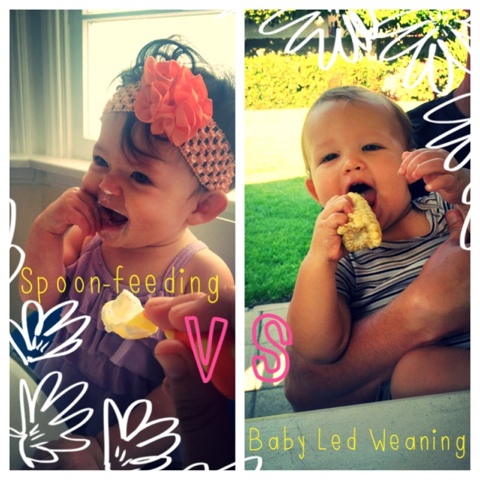
Traditional Puree/Spoon-fed Approach VS Baby Led Weaning

Baby Led Weaning vs spoon feeding

"Why have an 'approach' at all?" you might ask.  This may seems silly to those who just "do it" and never even consider what their personal "approach" might be.  "We just fed you" my mother said when I asked her about what she did for me.  "We didn't stop to think about approaches." 

4 generations of daughters enjoying lunch together.  We all were fed in different ways and I'd say we all turned out fairly well!

I get this.  Many people are too busy to consider the intricacies of a feeding style or they inherently trust their parenting skills and would never second guess themselves or confuse things by reading about someone's feeding philosophy.  But, many parents don't have this same sense of self-confidence or experience, and because we are more isolated than ever these days, we also don't have family or friends we can easily turn to for guidance. Additionally, if we look around at the incredibly high rates of picky eating childhood and adult obesity as well as the unbelievably high rates of funky childhood diseases, like autism, type II diabetes, asthma, and allergies, and digestive disorders (like Crohn's or Celiac), I think it becomes clear that whatever we have been doing--even when we are confident about it--has not really be working all that well.  We need guidance to find a better way.  Yes, I know that it's a leap to blame these ailments on the style a parent uses to introduce solids.  Of course that's not the full story, but I believe the way we start, often gives way to how we continue to interact with food, mealtimes, feeding and our children over the course of their childhood.  We all learn and improve as we go but we also build habits and routines that can be difficult to change. And when picky eating sets in, so does poor nutrition and unhealthy eating, which does contribute in a very real way to childhood and adult illnesses.

So, that being said, looking at theory and approaches can be helpful in terms of understanding what part of each approach works well and what doesn't.  It also helps the next person to learn from our mistakes and do it better from the start so that she doesn't have to undo bad feeding habits.

So, in the interest of making things easier and more sucessful, here is a chart that compares the two primary approaches to feeding an infant solid foods: Baby Led Weaning and Traditional Purees.


Baby Led Weaning Introduction to Solids
Benefits Drawbacks
  • Not focused on quantity and intake, so milk remains primary nutrition source

  • No need to prepare or buy “baby food”

  • Consistent exploration of solid food builds new oral motor patterns early on
  • Early and consistent practicing of new oral motor patterns helps to create a well coordinated skill set
  • Coordinated oral motor skills are important for eventual eating of resistive foods, such as vegetables and meats
  • Coordinated oral motor skills decrease a person's risk for choking
  • May decrease mealtime battles because baby is feeding him/herself and will either choose to eat or not

  • Self-feeding builds eye-hand coordination and fine motor skills

  • Uses a baby's inherent motivation to explore, discover, and self-feed 

  • Use of frequent modeling because parents eat the same thing as baby

  • Less focus on just baby at meals increases the focus on socialization and family time

  • Self-motivation is valued and practiced at each meal


  • Very messy

  • Gagging happens and looks scary

  • Over stuffing mouth is common at first

  • Increased risk of choking at first if done wrong (though physiologic protection from 5-8 months decreases this risk, as does supervision, always sitting baby upright in a supported seat and never putting food in the baby's mouth for him/her)

  • Possibly difficult for nanny, daycare, or unfamiliar feeder to do

  • Baby often is less likely to accept spoon feeding
because she enjoys feeding herself
  • Many parents worry they can't also give purees


Traditional (Puree) Introduction to Solids
Benefits Drawbacks
  • No choking risk at first

  • Baby uses very familiar oral motor patterns

  • Can be less messy if parent controls the spoon

  • Builds spoon skills quickly

  • Potentially faster/more efficient mealtimes 

  • Gets larger volume of food in baby from the start

  • Parent controls activity but can still be fun and “baby led” with a tuned-in parent

  • Some babies enjoy because there is less challenge initially

  • Some babies prefer bland flavors and textures

  • Less exploration by baby if parent spoon feeds

  • Easy to over ride inherent hunger/satiety cues by giving “1 more bite” or stopping before baby is done if not tuned-in

  • Quantity can easily become a focus with implications for decreased milk intake and mealtime battles

  • Delayed building of important oral motor patterns (I.e.- for chewing) 

  • Increased risk of choking later, after natural physiologic protection against choking is gone and textures are introduced

  • Purees are often bland

  • Less modeling because adults don't often eat purees for our meals
  • Uncertainty about when to progress to textured and finger-foods


Wednesday, June 5, 2013

Best First Foods


I know that what you want is a simple list of foods and maybe some recipes.  Instead I am giving you an essay. I am sorry. I am, truly. But I think part of the problem with health care for infants these days is that we're giving one-size-fits-all recommendations. And when it comes to first foods that is definitely the case. Whether or not the recommendation is rice cereal, vegetables, fruits, or even meats, our healthcare providers are emphatic about it being one of these options across the board for all babies. But with millions of babies out there, each with a different genetic make up, temperament, and home environment, there is no possible way that one idea will work for all. 

Often parents are surprised to hear that there may be more than one right choice for first foods. We assumed there is one right way and that's what has been recommended to us. Not so! Rather than a mediocre one-size-fits-all recommendation, parents need tools to make the best decision possible for their family and individual baby

That's what I want to offer in this post- guidance. Rather than 2 or 3 foods, which might be best for me and my child, but totally off for your baby, I'm going to give you ideas to consider in order to get at what will work best for you when choosing the best first foods. 

1. Consider what you and your partner's favorite foods are. 

2. Think about which foods are important to your culture and family. 

3. Take into consideration which foods are local and seasonal. 

4. Of course take into account your baby's nutritional needs (is she exclusively breastfeeding or is she taking formula? Iron needs may be higher in the baby who is fed formula, as an example. Or maybe intense allergies run in your family. Discuss your baby's unique needs with the pediatrician or a dietician.)

5. Consider your baby's temperament. For example, if your baby is spirited and likes to do things for herself, a "finger foods" approach, such as baby led weaning might be a good option. If your baby is content to be fed or is a really hungry baby that likes to eat quickly, a puréed and spoon-fed approach might be the more ideal way. Pick foods that lend themselves to the approach your child prefers. 

6. Gear your food choices and approach towards your baby's developmental readiness. If your baby is not sitting up independently yet but you have started introducing solids, purees are probably your safest bet, not finger foods. If your baby is just discovering his fingers and is loving to pick up small objects, finger feeding small bites might offer maximal enjoyment and motivation for feeding. Again, pick foods  that lend themselves to the approach that best fits your baby.

Once you've taken all this into account, it should be easier to pick certain first foods that will best suit your baby and your family. Run those ideas by your child's pediatrician and then bon appetit!